Ventura County Gyms Try to Stay Afloat During COVID-19 Pandemic Closure

By Brandon Freed

As of Dec. 7, Ventura County was issued a stay at home lockdown order with the recent increase in COVID cases across the county. However, gyms in Ventura County are trying the best they can to stay open in order to recover from their financial decline when they were forced to close down for four months from mid July until early Oct. Outside gyms are allowed to stay open right now. Private gyms are allowed to only hold private sessions and indoor gyms are supposed to be closed, but some are staying open for the time being.

Gyms remain open with caution

Simi Valley couple, Angela and Jeff Freed give their perspective and experience of what it’s like working out at Crunch Fitness during the COVID-19 pandemic. Angela decided to join Crunch Fitness earlier than Jeff and was able to convince him to join the gym to stay physically active.

Ventura County gyms are taking many precautions to ensure their members are working out in a safe manner during the current lockdown.

Exercise facilities that are allowed to remain open are outside gyms like Fitzone Ventura. Fitzone Ventura don’t require masks, but are highly recommended by the facility. 

“If people are exercising outside, we don’t want to risk people getting overheated with the masks on,” said Molly Phil, Owner of Fitzone Ventura. “We have sanitizing wipes outside, so people can clean the machines after they use them and we have all the machines spread apart to maintain a six feet distance.” 

Ladies at Fitzone Ventura practice social distancing while exercising outside its facility at 6 a.m. in the morning. They are following along with the instructor for class and refer to this session as Girl Power Hour. (Fitzone Ventura Instagram feed)

Indoor gyms like Fitness 19 are supposed to be closed down, but are instead staying open.

“We’re supposed to be closed down, but we’re going to continue to stay open,” said Cheyenne Robinson, a Fitness 19 sales associate in Thousand Oaks. “If we get fined for staying open, we’ll take it to court. Other indoor facilities have gone to court and they have won their cases, so we’re going to do the same.”

Instead of closing down, Fitness 19 ensures they’re doing the best they can to maintain a safe and healthy environment, starting with each active member has to wear a mask at all times inside the gym.

“Everyone has to have a mask on when they work out,” Robinson said. “We also limit the capacity of people inside the gym to just 10 percent, which is equivalent to 35 people and the work out machines are all spread apart to maintain social distancing.” 

Christopher Hahn, an active Fitness 19 member, says so far he has felt completely safe being back at Fitness 19. 

“Everyone is wearing masks and being very careful,” Hahn said. “With the limited capacity, we have a lot of room to work out and I feel completely safe.” 

A trainer at Fitness 19 holds plack showing the facility is sponsored by Stone Wright Biotech Services for its health and safety measures. Fitness 19 wants to ensure that the safety of their members is their main priority. (Fitness 19 Instagram Feed)

Private gyms like Anytime Fitness are taking a very cautious approach and are only allowed to hold private sessions during lockdown. 

“We have a system of cleaning the gym every hour,” said Jasmine Ababdali, Manager of Anytime Fitness in Simi Valley. “We don’t let our members use our towels or drink from our water fountains. They have to bring their own towels and water bottles.” 

Ababdali says their number one priority is the safety of their members.

“We only allow five or six people at a time for a private session in the facility, which is about five percent capacity,” Ababdali said. 

Gyms have financial set back during closure

With Gov. Gavin Newsome issuing a closure of indoor restaurants, hair salons and gymnasiums on July 13, gymnasiums in the Ventura County region suffered a financial decline during the four month closing period.

Phil said, “why would the gym members continue to pay when they aren’t able to use the gym? There is no point.” 

Fitzone Ventura ended up losing over half of its approximate 300 members during quarantine. 

“Losing half our members hurt us because it resulted in us losing about half of our overall revenue,” Phil said. “It’s definitely been a challenge for us to try and recover from that. It will take about a year and a half to two years to get back to where we used to be.” 

During the time Fitzone was closed, Phil said they had no option but to lay most employees off. 

“We were forced to lay everyone off except for the employees that were teaching virtual classes,” Phil said. “It was definitely not easy to make that decision.” 

Like Fitzone, Fitness 19 was forced to lay off their employees as well.

“When we lost most of our members, we weren’t making any money and had no other choice but to lay off all the employees,” Robinson said. “Since reopening, we’ve been able to rehire only three of our current 10 employees.” 

Private gym Anytime Fitness went through a similar situation financially, but was able to keep their employees because they received grants from the government.

Ababdali says over half of their members cancelled their membership during closure of the gym. 

“Many people closed their accounts or put their accounts on freeze,” Ababdali said. “This hurt our business because we weren’t making money. The only thing fortunate was that we didn’t lay off any employees. The trainers just weren’t able to make any money because they had no work, which was a struggle for them personally.” 

Gymnasiums Go Virtual During Quarantine

With the quick decision to close down gyms mid July, the gyms in Ventura County were forced to act quickly and work remotely to keep their businesses running.  

Phil said it was very hard at first to transition to remote workouts so quickly, but had no other option. 

“Going online and having private Zoom work out sessions with our members was all we could do at the time,” Phil said. “We even delivered weights and different equipment to their houses so they felt they weren’t losing out on anything. We did the best we could with the cards we were dealt with.” 

Robinson said the closure happened sooner than they thought and it took a couple of days to understand what virtual workouts would look like. 

“Once we got things up and running, we started to post classes on our Instagram page because that is our most active account,” Robinson said. “We currently have about 25 plus videos on our Instagram feed and they are all mentioned on our stories. When quarantine first began, we were posting our classes every day or every other day.”

Fitness 19 trainer Krista Horwitz, posts exercising class on Fitness 19’s Instagram page to allow its members to stay active during closure of the gym. Most of the videos that Horwitz posts are kickboxing classes. (Fitness 19 Instagram Page)

Robinson says they post a variety of classes. 

“We post classes like Zumba, Pilates, Kickboxing and many more,” Robinson said. “We just tried to keep our members as active as possible when our facility was shut down.”

Hahn says he appreciated the gym doing what they could, but working out over the computer just wasn’t the same.

“It was a lot different,” Hahn said. “I definitely missed working out at the gym and using all the equipment.”
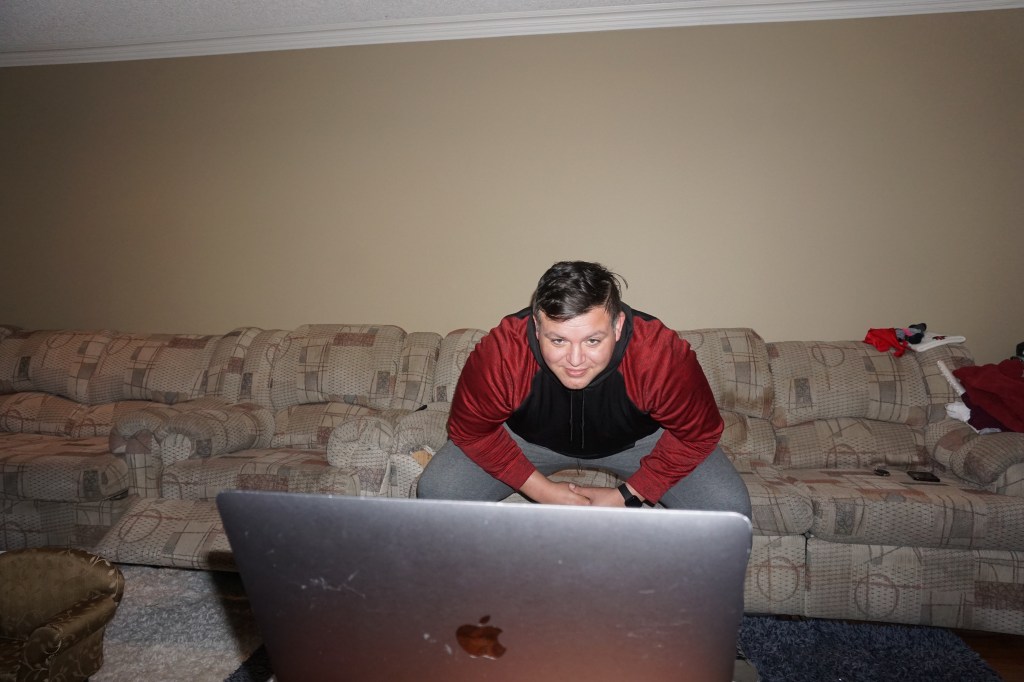
Christopher Hahn works out inside his living room while following a class on Fitness 19’s Instagram page. Hahn has been trying to workout as much as he can during quarantine to stay in shape for his job, which is an ice hockey official. (Photo by Brandon Freed)

Rebecca McFarland weight loss journey during quarantine
Culmination of JMS 430 Digital Journalism

The semester is officially coming to an end. I got the chance to take the JMS 430 Digital Journalism class at San Diego State University. I’m just going to go into a few different concepts I learned this semester, along with the assignments we had and our in-class laboratory discussions. 

We learned a lot of material about the digital journalism world this semester. At the beginning of the year, we talked about what digital journalism is. Digital journalism means that editorial content is posted on the internet. It’s basically online journalism. 

Then Professor Roman Koenig went into what journalists should do when trying to write a good story. He said it’s important journalists brainstorm ideas, come up with potential primary and secondary sources and even look at social media pages. Primary sources are sources that have first-hand knowledge or experience on the topic, whereas secondary sources are sources that have the reporting of others. 

About halfway towards the semester, we went into visual journalism. This was one of my favorite topics. “Photojournalism is about capturing life as it happens,” Koenig said. This interests me because it tells a story and focuses on the subject in front of the photographer. 

Later on, we went into data journalism. Data journalism is when journalists use the examination of statistics to enhance their story. Visually, you can show data through infographics. Infographics are visual elements that blend images and text together to convey information. When creating an infographic, I personally like to use charts to display the information I want people to see. 

The last couple items we discussed was building your own presence. You want to make sure your digital presence online represents who you are. It’s important to create your own website and have social media pages, so you can display your own work and be consistent with it in a professional way. 

In terms of our assignments, we had one very big assignment worth half our overall grade. We had to create a story package. The package was about writing a story based on a newsworthy topic that was somehow related to the COVID-19 pandemic in the San Diego area. This also included an infographic, pictures, tweets and an analytics plan. 

I really enjoyed writing my story as I chose to write about SDSU student reactions to going online. As I was receiving information from the three students I reported on, it was very interesting for me to see that the underclassmen were definitely more willing to go online than the seniors. The seniors are upset because the chance for them to walk at graduation was delayed. 

A couple things the students I reported on agreed with was that students should get money back for the switch to online since other schools have a cheaper price for classes online compared to on-campus classes. The students also agreed that the learning process has diminished because students don’t pay as much attention while they’re on Zoom compared to actually being in class. 

The challenge for me when I was writing the story was trying not to assume all students from the school had the same opinion as the three students I received my information from. The only way I would have known if all students had the same opinion is if I had all students take a survey. Another challenge for me was trying to find secondary sources because my story was about SDSU student reactions, so it took me a while to find information related to that.

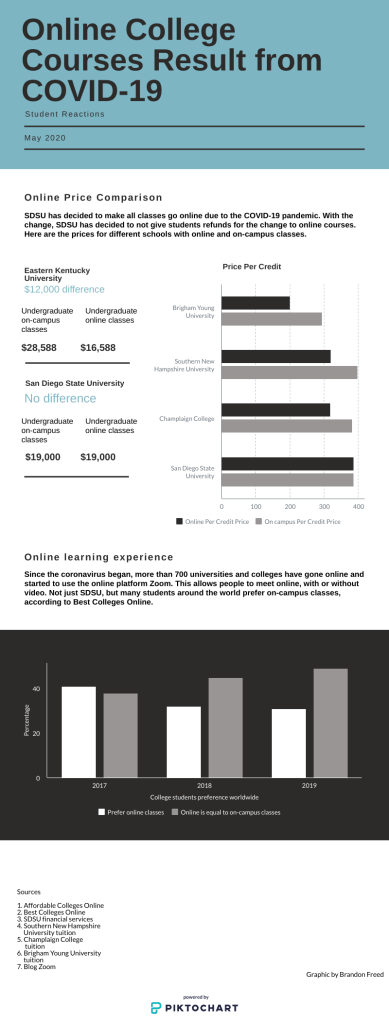
The infographic also took me a long time to create, but I’m proud of how it turned out. What I did for my infographic was I created two charts. The first chart showed other schools having different prices for online and on-campus classes compared to SDSU having no change in prices. The second chart I created displayed student reactions from around the world if they think online schooling is better or worse than on-campus classes. The majority of students agree that online school is worse. 

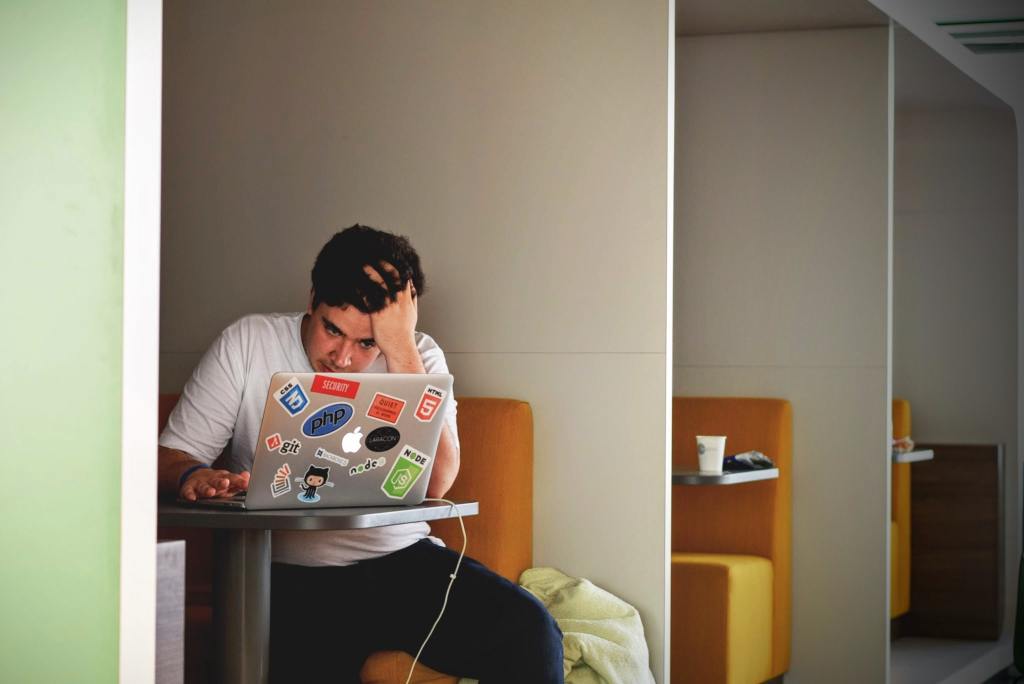
For the photo, I decided to use a picture from Unsplash because it had a great photo of a student showing a frustrated face while studying online. For support evidence, I embedded tweets from the Daily Aztec to show how students feel about the current pandemic and their reactions to the school’s decisions that were being made. 

In terms of the semester as a whole, I really enjoyed this class. I think making the class go online definitely made reporting and doing assignments harder because we can’t physically go to people. However, Koenig tried to do whatever he can to make our lives easier as a whole. He wrote long detailed emails to try and explain everything as best he could. He also put his lectures online, so we could all go on Blackboard and just read his lectures whenever we wanted. I thought that was more effective than other classes using Zoom because I really can’t focus and follow along with the teacher online, especially when I’m around friends and family at home. 

One thing I really did miss throughout the semester because the school made the decision to go online was the in-class laboratory discussions. I really enjoyed interacting with my classmates and teachers and having an overall good class discussion. I also learned and retained information better when I heard it first-hand from Koenig.

Portfolio

Student frustrated while studying online. Photo by Gouw, Tim via Unsplash

San Diego State students react to transition to online classes

COVID-19 forces students to adapt quickly to changes made by SDSU’s front office 

“I would have to say I’m disappointed, and confused in how the university handled the situation,” San Diego State University senior, Cristian Alvarez said. “I understand that the situation was changing constantly with how things escalated, but their communication team did a poor job of letting the students know in a timely manner. There have been many poor decisions on behalf of the university and students were left scrambling.”

Alvarez is referring to his impression of how SDSU handled the COVID-19 pandemic and its decision to make all classes go online starting March 10. In the weeks since, many SDSU students have shared their own thoughts on the change on social media and to local news outlets.  

Did SDSU make the right decision to go online?

Current junior student Nick Grewal said he believes the change to online classes was necessary. 

“I completely agree with the school’s decision to go online,” Grewal said. “It was the right choice to make not only for the safety of the students, but their families and the city of San Diego as a whole.” 

As of April 29, 3,432 people had been confirmed to have caught the coronavirus and 120 of those people had died in San Diego, according to San Diego government data. This is the fourth-highest death rate in California and the numbers are continuing to grow. 

SDSU also announced that one of its senior students caught the coronavirus while they were studying abroad in Italy. As a result, the safety and health of the student body is the school’s number one priority, SDSU president, Adela de la Torre said.

Another junior student, Breven Honda, thought the change was needed as well. 

“I agree with the school’s decision to go remote because all schools across all levels are doing it to maintain physical distancing,” Honda said. “From elementary to high school and college, it is happening.”

From a different perspective, Alvarez said he doesn’t believe the school should have made the decision to go fully online. 

“I would have to say overall I disagree,” Alvarez said. “I can see why they did because obviously some students want to stay on track and graduate on time. However, I think the transition to online can be stressful for students especially during this pandemic. Lots of people are worried over how this coronavirus situation is going to pan out and the last thing on their minds is school. I think there is also a significant amount of people upset about not getting their money’s worth for their education.”

With the university closing on-campus classes, getting to walk at graduation has also been shut down for the current senior class. The school announced in an email on March 20 that seniors would have an online graduation in May through an online platform called Zoom. It won’t be until December when students will actually be able to walk and celebrate commencement. 

Should students receive money back for online courses?

According to Affordable Colleges Online, there can be a big difference for prices between online classes and on-campus classes.

At Eastern Kentucky University, for example, there is about a $12,000 difference between online and on-campus classes per year. Online classes cost $16,580 and on-campus classes cost $28,588. 

In terms of SDSU’s prices, there is no difference between on-campus and online classes, according to SDSU financial services. The cost for an undergraduate full-time student for 6.1 units is $3,860. This is equivalent to about $9,500 for the average student taking 15 units per semester or $19,000 for the year.  

After many emails coming quickly from SDSU, Alvarez said he believes it’s not right that students are forced to transition and get used to online classes and the students are not getting any sort of refund for the change. He thinks it really hurts the students who prefer on-campus classes. 

“Without a doubt, I think it is wrong,” Alvarez said. “Every student attending SDSU at the moment are not getting the full benefits from attending the university. Nearly all the campus resources are unavailable and yet we still have to pay the same price as if we are still going in person. The same goes with the classes. Most people choose to do their education in person for courses. Having to do them online gets frustrating especially for the majors which are already stressful enough in person. I’m talking about majors like engineering, chemistry, etc.”

Honda expressed a similar point of view. 

“In a way, I feel it is wrong that we are paying the regular amount for tuition because students are not able to utilize the facilities on campus,” Honda said. 

Grewal also shared a similar perspective. 

“I do think it is wrong that we are paying a normal price for online school because of the fact that the quality of education has gone down,” Grewal said. “The SDSU experience and standards of education slightly drop when classes go online so the price of tuition should accurately reflect that.” 

President de la Torre said the school would be willing to give a few reimbursements back to some SDSU students.

“As we have shared in earlier communications, student housing and meal plan prorated reimbursements have been offered to students who have to leave campus early,” de la Torre said. “The university is also offering prorated reimbursements for student permit parking and employee payroll deductions for parking, upon request to Parking Services, if they are not on campus.”

However, nothing was mentioned about refunding students for the transition to online classes. 

Do students learn better online?

Grewal said he finds that going online is distracting from the learning process. 

“I believe the online classes are worse for me just because I find it harder to focus on watching video lecture after video lecture and not having a physically enhancing relationship with professors and content,” Grewal said. 

Honda said he believes the learning process is both good and bad, however.

“It’s better because of the pace and mental aspect,” Honda noted. “There is not as much anxiety as to attending class. It is also defeating because by being 100% remote, you can’t have the face-to-face interaction as you would in a class in addition to any extracurricular activities you are a part of.”

As the trend continues, Alvarez said he believes the learning process has taken a big hit. 

“I think it’s worse in the sense of what you’re actually learning,” Alvarez observed. “There are many collaborations between classmates of passing answers to each other. While that leads to getting high grades and stuff, in the long run I don’t think it helps you learn as much. Being in person gets you to be more on top of your work and go through the material. That’s just my opinion from what I’ve experienced in doing both online and in-person classes.” 

A study from SAGE Journals shows that students taking courses online have a 10% to 20% higher failed retention rate compared to students taking traditional on-campus classes.

This project was produced by Brandon Freed as a published learning experience in JMS 430 Digital Journalism, part of the Journalism and Media Studies Program at San Diego State University.

JMS 430 Update 5

This is the time of the semester where everything is starting to pile on me with every class coming to an end. Every one of my classes has a big assignment going on and I’m just going to take the approach of completing one assignment at a time.

In terms of the final story that we’re doing, I’m having a little bit of a hard time trying to find the pictures of students dealing with the transition to online school because of the coronavirus. For the infographic, I definitely know that I will have a graph comparing the prices of on-campus classes and online classes from other schools. I will also show statistics and facts that shows a difference in the learning process between on-campus and online classes. As far as what I’m going to improve on from the first story draft is I’m going to make all the GSP errors I had from the first time and I’m going to change the beginning of my story as it was more opinionated. I’m going to start the story with a quote from one of my sources. I’m also going to make my subheads shorter because they were almost like sentences. I’m also going to make the story flow a bit better as the story is currently a bit choppy. I’m also going to make my paper a word document because I accidentally made it a pdf. document the first time.

As far as what we are currently learning on in class, we’re looking at social media strategies and analytics. What’s important about this is that your social media site is very engaging and connects with the community. I think what’s the most important aspect of your social media site is the timing of when you’re posting or tweeting something. It’s important to post things that connect with the news that is going on around you.

JMS 430 Update 4

We have about three weeks left in the semester. Being home and completing classes online has become a lot harder for me. It has definitely been harder for me to stay focused and complete all my school work because my priority right now is not school, but rather staying healthy. My parents keep updating me that more people are catching the coronavirus in my hometown and the city I live in, Simi Valley. I also have had a cold recently, so I’ve been trying to make sure I don’t get really sick.

As far as completing my assignments, with being sick recently, it has become very difficult. It has been really hard for me to contact sources for all the articles I’m writing right now. I have articles to write in all my classes, but I’m just going to continue to fight my sickness right now and continue to reach as many people as I possibly can. For one of my classes, I have to contact a journalist in Barbados. At least in this class, i’m just contacting people that attend San Diego State University for my final story. I have contacted two juniors and a senior. For me personally, I feel really bad for the seniors because they are going to have to wait till December to graduate and depending on where they live or if they have a job or some other reason, they might not be able to come back to San Diego in December. In my story, I want to talk about the students reaction to not getting money back and how they feel about the online learning process.

As a result, I just want to say, school was a lot easier for me when we still had on-campus classes. I definitely miss that in class engagement with my classmates and my professors. I also retained more information and focused more when I attended class.

JMS 430 Update 3

Since the school made the decision to make all classes online, it’s definitely made me realize that I have not been able to learn as much with the change. This class has been great because the professor is posting his lectures online for all of us to look at during the week, so we can still learn and teach ourself the material. It’s definitely better when the professor is teaching us in person, but at least professor Koenig posts his lectures online, whereas some teachers don’t post their lectures online and expect the students to be on Zoom for every class. Sometimes students might not be able to make every class and login to Zoom for class, so I like that Koenig posts his lectures online, so we can view the material whenever. Lately in this class, we have been learning about headline and caption writing. Headlines are important because they are supposed to catch the readers attention.

JMS 430 Update 2

The school has made the decision to make all on-campus classes to go all online as a result of the Covid-19 pandemic that originated in China and has now made its way to San Diego. This class has been changed by the professor because the school can’t make students go to people and ask to interview them for safety reasons. The professor has now switched our major assignment for the year by making it about a big coronavirus story instead. The idea that I am going to talk about in regards to the coronavirus is how the SDSU students are handling the situation of making all classes go online. Many students have mixed emotions about the schools decision.

Featured

JMS 430 First Blog Post

Journalism

Be Great

— Brandon Freed

JMS 430 is a digital journalism class that I am currently taking. So far in class, we have discussed what makes effective writers. We have gone over AP style and have looked over papers where their were many grammatical errors, so we could correct them. We have discussed what makes effective writers and what styles of writing catches the readers attention right away. For instance, it’s important to say the main point of what you’re writing about right away and this is called a hard lead. We do a lot of class discussions as well and I like that because it gets us all involved in class and makes going to class more fun hearing from different peoples perspectives on certain things. So far, I have really enjoyed the class and I appreciate that our professor really wants us to understand the material and become better writers, so we all excel in the real world after we graduate.