San Diego State students react to transition to online classes
COVID-19 forces students to adapt quickly to changes made by SDSU’s front office
“I would have to say I’m disappointed, and confused in how the university handled the situation,” San Diego State University senior, Cristian Alvarez said. “I understand that the situation was changing constantly with how things escalated, but their communication team did a poor job of letting the students know in a timely manner. There have been many poor decisions on behalf of the university and students were left scrambling.”
Alvarez is referring to his impression of how SDSU handled the COVID-19 pandemic and its decision to make all classes go online starting March 10. In the weeks since, many SDSU students have shared their own thoughts on the change on social media and to local news outlets.
Did SDSU make the right decision to go online?
Current junior student Nick Grewal said he believes the change to online classes was necessary.
“I completely agree with the school’s decision to go online,” Grewal said. “It was the right choice to make not only for the safety of the students, but their families and the city of San Diego as a whole.”
As of April 29, 3,432 people had been confirmed to have caught the coronavirus and 120 of those people had died in San Diego, according to San Diego government data. This is the fourth-highest death rate in California and the numbers are continuing to grow.
SDSU also announced that one of its senior students caught the coronavirus while they were studying abroad in Italy. As a result, the safety and health of the student body is the school’s number one priority, SDSU president, Adela de la Torre said.
Another junior student, Breven Honda, thought the change was needed as well.
“I agree with the school’s decision to go remote because all schools across all levels are doing it to maintain physical distancing,” Honda said. “From elementary to high school and college, it is happening.”
From a different perspective, Alvarez said he doesn’t believe the school should have made the decision to go fully online.
“I would have to say overall I disagree,” Alvarez said. “I can see why they did because obviously some students want to stay on track and graduate on time. However, I think the transition to online can be stressful for students especially during this pandemic. Lots of people are worried over how this coronavirus situation is going to pan out and the last thing on their minds is school. I think there is also a significant amount of people upset about not getting their money’s worth for their education.”
With the university closing on-campus classes, getting to walk at graduation has also been shut down for the current senior class. The school announced in an email on March 20 that seniors would have an online graduation in May through an online platform called Zoom. It won’t be until December when students will actually be able to walk and celebrate commencement.
Should students receive money back for online courses?
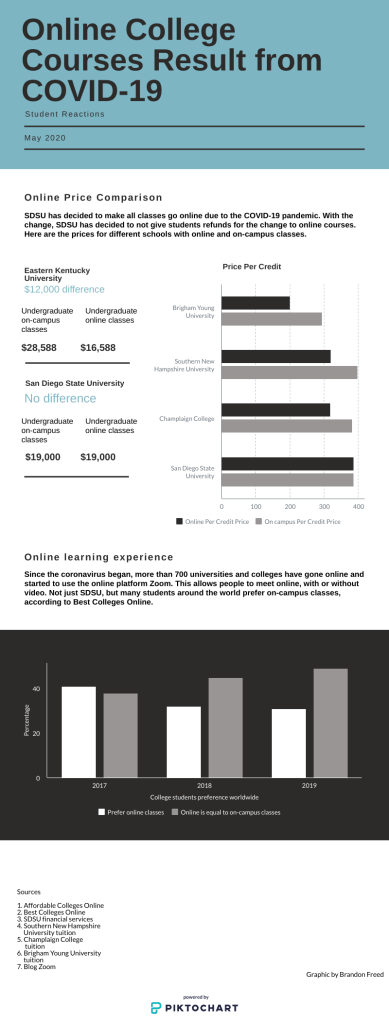
According to Affordable Colleges Online, there can be a big difference for prices between online classes and on-campus classes.
At Eastern Kentucky University, for example, there is about a $12,000 difference between online and on-campus classes per year. Online classes cost $16,580 and on-campus classes cost $28,588.
In terms of SDSU’s prices, there is no difference between on-campus and online classes, according to SDSU financial services. The cost for an undergraduate full-time student for 6.1 units is $3,860. This is equivalent to about $9,500 for the average student taking 15 units per semester or $19,000 for the year.
After many emails coming quickly from SDSU, Alvarez said he believes it’s not right that students are forced to transition and get used to online classes and the students are not getting any sort of refund for the change. He thinks it really hurts the students who prefer on-campus classes.
“Without a doubt, I think it is wrong,” Alvarez said. “Every student attending SDSU at the moment are not getting the full benefits from attending the university. Nearly all the campus resources are unavailable and yet we still have to pay the same price as if we are still going in person. The same goes with the classes. Most people choose to do their education in person for courses. Having to do them online gets frustrating especially for the majors which are already stressful enough in person. I’m talking about majors like engineering, chemistry, etc.”
Honda expressed a similar point of view.
“In a way, I feel it is wrong that we are paying the regular amount for tuition because students are not able to utilize the facilities on campus,” Honda said.
Grewal also shared a similar perspective.
“I do think it is wrong that we are paying a normal price for online school because of the fact that the quality of education has gone down,” Grewal said. “The SDSU experience and standards of education slightly drop when classes go online so the price of tuition should accurately reflect that.”
President de la Torre said the school would be willing to give a few reimbursements back to some SDSU students.
“As we have shared in earlier communications, student housing and meal plan prorated reimbursements have been offered to students who have to leave campus early,” de la Torre said. “The university is also offering prorated reimbursements for student permit parking and employee payroll deductions for parking, upon request to Parking Services, if they are not on campus.”
However, nothing was mentioned about refunding students for the transition to online classes.
Do students learn better online?
Grewal said he finds that going online is distracting from the learning process.
“I believe the online classes are worse for me just because I find it harder to focus on watching video lecture after video lecture and not having a physically enhancing relationship with professors and content,” Grewal said.
Honda said he believes the learning process is both good and bad, however.
“It’s better because of the pace and mental aspect,” Honda noted. “There is not as much anxiety as to attending class. It is also defeating because by being 100% remote, you can’t have the face-to-face interaction as you would in a class in addition to any extracurricular activities you are a part of.”
As the trend continues, Alvarez said he believes the learning process has taken a big hit.
“I think it’s worse in the sense of what you’re actually learning,” Alvarez observed. “There are many collaborations between classmates of passing answers to each other. While that leads to getting high grades and stuff, in the long run I don’t think it helps you learn as much. Being in person gets you to be more on top of your work and go through the material. That’s just my opinion from what I’ve experienced in doing both online and in-person classes.”
A study from SAGE Journals shows that students taking courses online have a 10% to 20% higher failed retention rate compared to students taking traditional on-campus classes.
This project was produced by Brandon Freed as a published learning experience in JMS 430 Digital Journalism, part of the Journalism and Media Studies Program at San Diego State University.

 familyjournalist.family.blog